


Church Roof Risk & Inspection Guide
HERITAGE GUIDANCE SERIES
Designed for Church Wardens, PCCs, clergy and heritage custodians, this practical guide helps you identify common roof risks, understand where problems develop, and make more informed maintenance decisions before minor defects become major repairs.
✅ CAA Approved Operations
✅ Fully Insured
✅ Independent Reporting
✅ Non Intrusive
✅ UK Wide Coverage
This guide forms part of the Three Weave Heritage Guidance Series, alongside practical resources, real inspection case studies, and the Church Wardens Hub to support informed fabric stewardship.
Protecting historic churches starts with understanding their condition
Church Wardens, PCC's, Heritage Custodians
Audience
Approximately 10 minutes
Reading Time
Inspection checklist, risk and maintenance planning
Includes
Free
Cost
Many of the most costly roof defects begin in areas that are rarely seen from ground level. This guide has been developed to help those responsible for caring for church buildings recognise early warning signs, prioritise maintenance, and support informed conversations with PCCs, dioceses and professional advisers.
INSIDE THE GUIDE
➡️ Practical inspection checklist
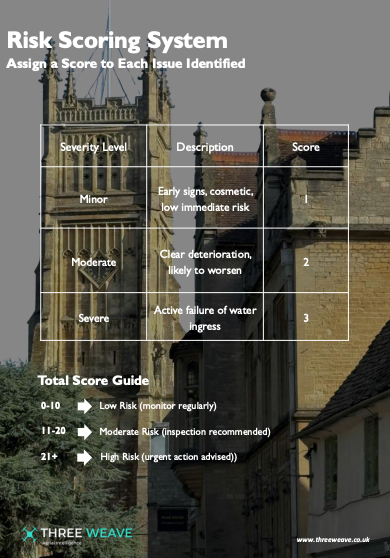
➡️ Church roof risk scoring framework
➡️ Common warning signs explained
➡️ High-risk areas to prioritise
➡️ Maintenance planning guidance
➡️ Inspection frequency recommendations
➡️ Next step advice
• Built for Church Wardens • Preventative Stewardship • Real Heritage Experience • Free Resource

Why Church Roofs Deserve Proactive Attention

Caring for a historic church is about far more than responding to visible defects. Many of the most significant roof problems begin gradually, developing in areas that are difficult or impossible to inspect safely from ground level.
A slipped slate, blocked valley gutter or failing lead detail may seem insignificant at first, yet over time these issues can allow water to penetrate the building fabric, leading to damage that is often far more extensive and costly to repair.
For Church Wardens, PCCs and clergy, the challenge is rarely a lack of commitment—it is knowing where to look, what to look for, and how to prioritise maintenance with confidence.
This guide has been created to support that process.
Why We Created This Guide
Historic churches deserve more than reactive maintenance
At Three Weave, we work alongside those responsible for caring for heritage buildings by providing clear, independent aerial intelligence that supports informed maintenance decisions. Through our work with churches and heritage properties, we've seen how many significant defects begin as small, hidden issues that often remain unnoticed until costly repairs become unavoidable.
We created this guide to share practical knowledge that helps Church Wardens, PCCs and heritage custodians recognise common warning signs, understand where risks develop, and build greater confidence in managing the long-term care of their buildings.
Whether you choose to use this guide on its own or as part of a wider inspection programme, our aim is the same: to support better stewardship through better information.

The Cost of Small Problems Going Unnoticed

Many church roof defects remain hidden for months—or even years—before visible signs appear inside the building.
By the time damp patches, staining or damaged plaster become obvious, water may already have travelled through roof coverings, timber structures and masonry.
Early identification allows maintenance to be planned rather than forced by emergency repairs, helping churches:
-
protect historic fabric
-
reduce disruption
-
prioritise limited maintenance budgets
-
support informed PCC decision making
-
provide better evidence when engaging professional advisers or insurers
Preventative stewardship is almost always more cost-effective than reactive repairs.
Two Paths From a Small Issue
A Small Issue
on the roof or fabric

Who This Guide Is For

Church
Wardens

PCC
Members
Support maintenance discussions with greater confidence and clearer evidence. Learn more at our Church Wardens Hub

Clergy
Understand the condition of the buildings entrusted to your care. See the resources that can support your Church Wardens.

Diocese
Property Teams
Encourage consistent inspection approaches across multiple churches. How we support church buildings with aerial intelligence.

Heritage
Custodians
Improve long-term stewardship of historically significant buildings. See more about Heritage aerial intelligence.

Insurers & Professional Advisers
Gain insight into a structured approach to early risk identification that complements professional assessment.
What's included in the Church Roof Risk & Inspection Guide
Inspection checklist
Step-by-step guidance to help identify common visible defects
Risk Scoring Framework
A simple method for prioritising issues and planning next steps.
High Risk Church Areas
Focus attention in the locations where problems most commonly develop.
Maintenance Planning
Guidance to support preventative fabric stewardship throughout the year.
Warning Signs Explained
Understand why apparently minor defects can become significant if left unattended.
Next-Step Recommendations
Know when continued monitoring is appropriate and when further professional inspection should be considered.
Ready to Explore the Guide ?
Download your free copy and start building a clearer understanding of your church roof's condition.
INSIDE THE GUIDE
➡️ Practical inspection checklist
➡️ Church roof risk scoring framework
➡️ Common warning signs explained
➡️ High-risk areas to prioritise
➡️ Maintenance planning guidance
➡️ Inspection frequency recommendations
➡️ Next step advice
Page extracts:



Every page has been designed to provide practical, easy-to-follow guidance that supports confident decision making and preventative maintenance planning.

Understanding Church Roof Risk
Historic church roofs are among the most complex structures found in the built environment. Unlike modern buildings, they combine centuries of construction techniques, multiple roofing materials, intricate drainage systems and architectural features that naturally create areas of increased vulnerability.
Many defects begin gradually and remain hidden long before they become visible inside the church.
Understanding where these risks develop is the first step towards effective preventative stewardship. To learn more visit our Church Wardens Hub.

Historic Construction
Different materials and construction periods create unique challenges.

Historic Construction
Rainwater must move efficiently across complex roof layouts and drainage systems.

Hidden Areas
Many high-risk locations cannot be inspected safely from ground level.
Where Problems Commonly Begin

Valley Gutters
Water naturally concentrates here, making them one of the most common locations for blockages, deterioration and long-term water ingress. Regular inspection is essential to ensure they remain clear and functioning effectively.

Lead Flashings
Lead components expand and contract with seasonal temperature changes. Over time, movement, fatigue and weathering can reduce their effectiveness, allowing water to penetrate vulnerable junctions. Read our article that highlights common defects.

Parapet Gutters
Often concealed behind masonry, parapet gutters can collect debris and retain standing water without obvious external signs. Because they are largely hidden from view, problems frequently go unnoticed until internal damage occurs.

Roof Coverings
Slipped slates, cracked tiles and displaced ridge details may appear isolated, yet even small openings can allow water to enter the roof structure over time.

Towers & Spires
Changes in roof geometry create additional joints, flashings and drainage complexities. These areas often experience increased weather exposure and require careful monitoring. Read our article on inspecting towers and spires.

Chimneys & Masonry
Changes in roof geometry create additional joints, flashings and drainage complexities. These areas often experience increased weather exposure and require careful monitoring. Visit our chimneys section.
Why Small Defects Become Major Problems
Most significant roof failures do not occur overnight.
They begin with relatively minor defects that often remain unnoticed during routine ground-level observations.
A blocked gutter may gradually overflow.
A slipped slate may expose an underlay.
A failed lead joint may admit only small amounts of water.
Individually these issues may appear insignificant.
Collectively—and over time—they can lead to moisture entering roof structures, damaging masonry, timber, ceilings and decorative finishes before obvious symptoms become visible inside the building.
Early identification provides greater flexibility, allowing maintenance to be planned and prioritised rather than dictated by emergency repairs.
What Can Be Seen from Ground Level ?

Ground-level observations remain an important part of routine stewardship.
However, many of the areas most susceptible to deterioration are positioned high above ground or concealed by architectural features.
Understanding these limitations helps church custodians make informed decisions about when additional investigation may be appropriate.

A Smarter Way to Understand Roof Condition

When routine observations identify potential concerns—or when areas simply cannot be viewed safely from ground level—aerial intelligence provides an effective way to gain greater clarity.
Rather than relying on assumptions or costly access equipment for an initial assessment, high-resolution aerial imagery can provide detailed visual information across complex roof structures.
This supports:
✔ evidence-based maintenance planning
✔ informed PCC discussions
✔ clearer prioritisation of repairs
✔ improved communication with professional advisers
✔ documented visual records for future comparison
Three Weave specialises in capturing this visual intelligence to help heritage custodians better understand the condition of their buildings while supporting long-term preventative stewardship.
Stewardship is a Continuous Process
Looking after a historic church is not about responding to isolated defects. It is an ongoing process of observation, informed decision making and planned maintenance.
By building a consistent understanding of roof condition over time, churches are better placed to protect historic fabric, manage maintenance budgets and preserve their buildings for future generations.
This is exactly the philosophy that underpins Three Weave's approach to Heritage Aerial Intelligence.

Continue Exploring Heritage Resources


Important Information
Three Weave provides aerial inspection and visual intelligence services only and does not undertake formal surveys or structural assessments. This guide is intended to support early-stage risk identification and maintenance planning. Professional advice should be sought where required.