

Church Masonry: A Specialist Approach to Inspection, Maintenance and Conservation
Church masonry is vital to a church’s character and condition, but it is often difficult to inspect properly at height. This article looks at the key issues and how aerial intelligence can support better maintenance and stewardship.
Church masonry is one of the most important elements of a church’s external fabric, and also one of the most vulnerable. For church wardens, diocesan teams and PCC members, understanding the condition of masonry is fundamental to responsible church stewardship, long-term conservation planning and effective building fabric condition management.
In many churches, masonry forms the largest material surface of the building. It is also frequently the most difficult to inspect in full, particularly at height, where access is limited and defects can be concealed by distance, shadow, weathering and intricate architectural detailing. As a result, significant issues may remain unnoticed until they have developed into more serious repair concerns.
The vulnerability of church masonry
Church masonry is exposed continuously to the effects of weather, movement and age. Over time, stonework and mortar joints can deteriorate through open cracks, erosion, spalling, friable surfaces, biological growth, water ingress and localised structural movement. These problems rarely appear all at once. More often, they develop gradually across walls, towers, parapets, buttresses, tracery and other elevated features.
Because church masonry is so extensive, even a relatively small number of defects can have a disproportionate effect on the building as a whole. A single defect may be localised, but it can also indicate wider issues affecting moisture penetration, material compatibility or long-term stability. For that reason, good heritage building maintenance depends on more than visual awareness alone.
Why specialist knowledge is essential

The care of church masonry requires specialist understanding of traditional materials, historic construction and appropriate repair methods. Heritage building maintenance is not simply a matter of replacing damaged stone or repointing visible openings. It requires informed diagnosis, careful specification and a conservation-led approach that respects the significance of the building.
This is particularly important in the context of preventative conservation. Early intervention, informed by proper inspection and expert analysis, can reduce the need for larger and more disruptive repairs later. It also helps ensure that repairs are compatible with the original fabric, rather than introducing materials or methods that may accelerate deterioration over time.
For church wardens and PCC members, specialist advice provides confidence that maintenance decisions are based on evidence, not assumption. For diocesan teams, it supports a more consistent and strategic approach to conservation planning across multiple buildings.
The difficulty of seeing masonry at height
One of the greatest challenges in assessing church masonry is visibility. Much of the building’s most important fabric is elevated, remote from ground level and inaccessible without specialist access equipment. Upper wall faces, gables, towers, parapets and ornamental stonework are often the areas where defects first emerge, yet these are also the areas most difficult to examine properly.
Ground-level inspection alone rarely provides complete coverage. Even when carried out carefully, it may miss fine cracking, open joints, displaced stone, failed mortar or subtle staining patterns that indicate moisture movement. In a complex historic church, the true condition of the masonry can therefore be underestimated unless the inspection method is capable of capturing the full building envelope.
This is where building fabric condition surveys need to go beyond the traditional view. A partial assessment can be useful, but it may not be sufficient to support reliable conservation planning or repair prioritisation.
Unsure what condition your masonry is in ?
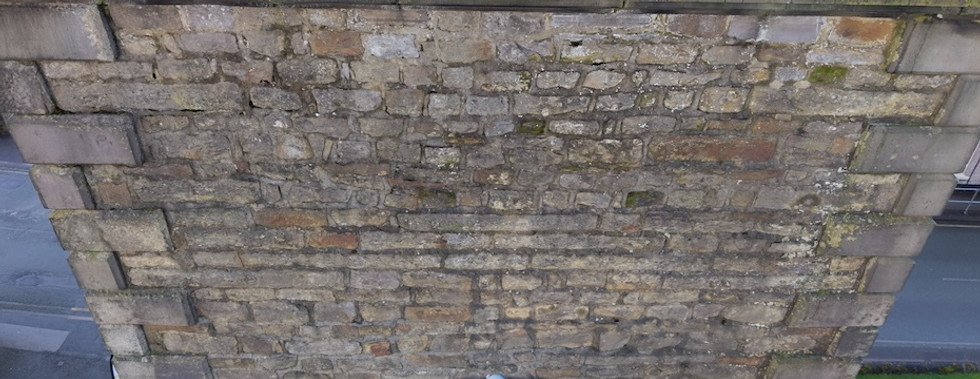
Identifying masonry defects from ground level can be challenging, particularly on towers, parapets and other difficult-to-access areas.
Detailed aerial imagery can help church wardens, PCCs and professional advisers assess condition more effectively and prioritise maintenance decisions. More information here.
How aerial intelligence supports maintenance
Drone technology has transformed the inspection of hard-to-reach masonry. High-resolution aerial imagery makes it possible to examine elevated stonework and walls safely, efficiently and in far greater detail than ground-based observation alone. This enables more complete coverage of the building and allows hidden or difficult-to-see defects to be recorded accurately.
When imagery is combined with machine-based analysis, the value increases further. Digital review systems can help identify patterns of deterioration, highlight areas of concern and organise large volumes of inspection data into a more practical format for decision-making. This gives church wardens, PCC members and heritage specialists a clearer view of current condition and likely future maintenance needs.
Aerial intelligence is particularly powerful because it supports both preventative conservation and repair-based maintenance. It allows minor issues to be identified earlier, monitored over time and addressed before they become more serious. That makes it a valuable tool for churches seeking a more proactive and sustainable approach to care.
Supporting church stewardship
For churches, effective stewardship means making informed decisions about a building that carries both spiritual and heritage significance. Church masonry is a core part of that responsibility, and it benefits greatly from timely inspection and specialist guidance.
Aerial intelligence does not replace the role of the conservation professional. Rather, it strengthens it. By providing detailed visual evidence and structured condition data, it helps specialists assess masonry more thoroughly and helps decision-makers understand where priorities lie. It also supports better communication between church leaders, advisers and contractors, whether works are being planned for immediate repair or long-term maintenance.
This makes drone-based inspection and machine-assisted analysis highly relevant to modern church stewardship. They offer a practical route to better visibility, better planning and better conservation outcomes.
What Church Wardens Should Look For
Church wardens should be alert to the early signs of masonry deterioration, as these often indicate wider issues within the building fabric condition. Key warning signs include open joints, missing mortar, stone delamination, bulging masonry, cracks, vegetation growth, water staining, frost damage and failed pointing. Identifying these defects early helps transform routine observation into meaningful preventative conservation and supports more informed church stewardship.
A practical path forward
Church masonry will always require care, but the way it is inspected and managed can be improved. For church wardens, diocesan officers and PCC members, the combination of specialist knowledge, aerial intelligence and structured reporting provides a stronger foundation for informed action.
By improving the visibility of high-level walls and other difficult areas, drone technology helps reveal the true building fabric condition. By using machine-based analysis, it supports conservation planning that is more accurate, more consistent and more proactive. And by enabling early identification of defects, it contributes directly to preventative conservation and responsible heritage building maintenance.
For churches that wish to protect their fabric with greater certainty, this approach offers a modern and effective way forward.

Go to our heritage specific page and see how aerial intelligence works for heritage properties.
We have built a page specifically for Church Wardens, where tools and guides can be found.
See our frequently asked questions concerning heritage aerial intelligence. These cover a wide range of topics.